Google Is Changing — Here's What That Means for How Customers Find Your Shop
As AI rewrites search results pages, the organic Google traffic your service business depends on is getting less reliable — and it's time to diversify where new customers come from.
The Search Results Your Customers See Are Changing Fast
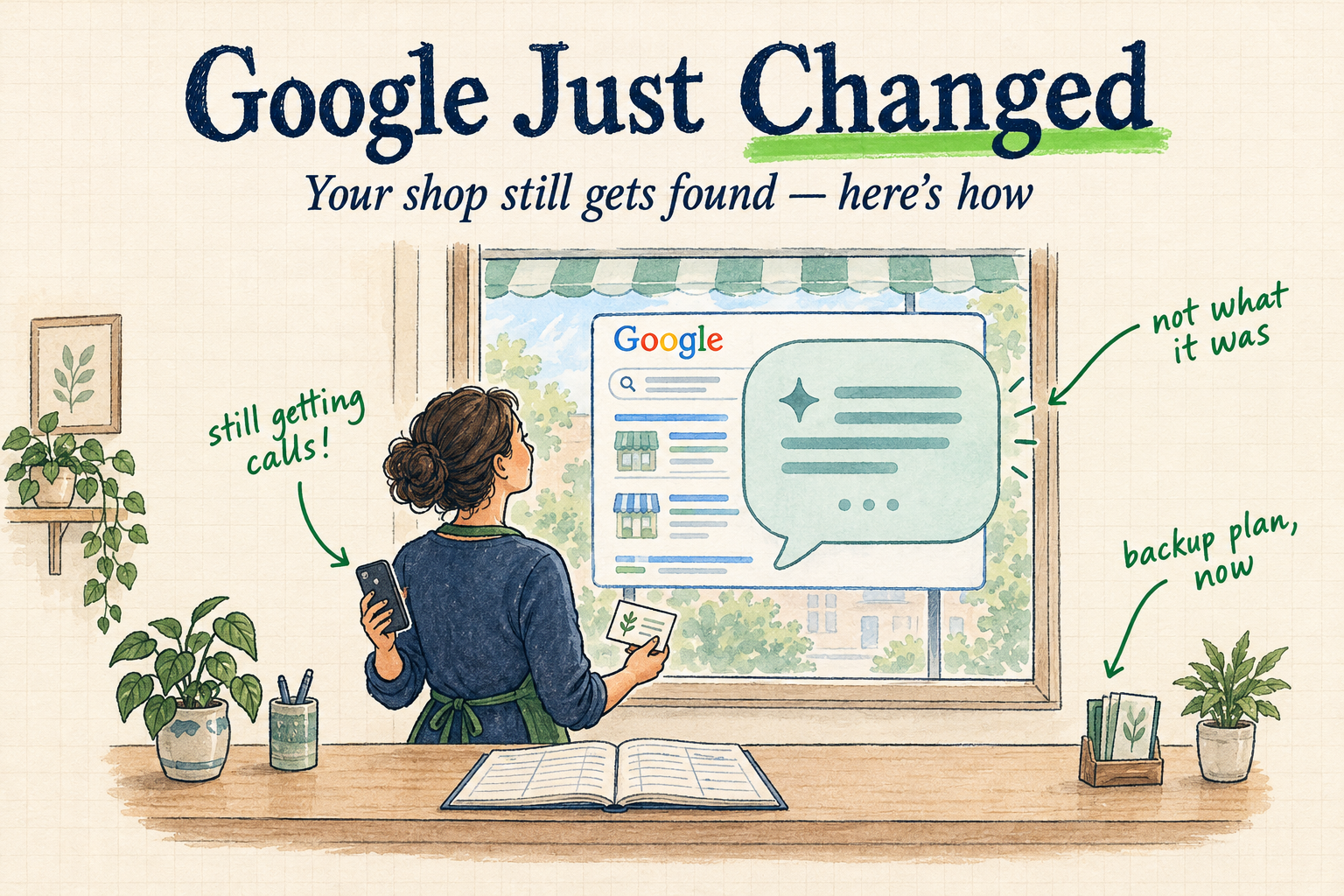
Google has been quietly rewriting how its results pages look — and if your service business depends on showing up at the top of a local search, you need to pay attention.
The shift is called AI Overviews. Instead of a list of ten blue links, Google now generates a summary answer at the top of the page and pulls information from multiple sources. For searches like "how often should I service my HVAC system" or "what's included in a deep cleaning," Google answers the question directly. The customer gets what they need without clicking anything.
That matters for local SEO service business owners because the traffic model you've been building on — rank well, get clicks, get calls — is getting less reliable.
What's Actually Happening to Your Traffic
Here's the concrete version: a plumbing company in Phoenix had been averaging 400 organic visitors per month from Google. After AI Overviews started appearing on informational searches in their category, that dropped to around 280. They didn't lose their rankings. The clicks just didn't happen because Google answered the question before the customer got to them.
That's a 30% traffic drop with no algorithm penalty and nothing they did wrong. Their local SEO was still working. The environment changed around them.
This isn't isolated. Across service categories — salons, dental practices, fitness studios, cleaning companies — businesses that rely heavily on organic search are seeing similar patterns on informational queries. The high-intent transactional searches ("HVAC repair near me," "book a haircut in Austin") are still generating clicks for now. But that window may narrow.
The Three Channels That Still Work
Diversifying doesn't mean abandoning Google. It means not betting the entire customer acquisition model on one channel you don't control.
1. Google Business Profile — Not Optional
Your GBP listing is different from organic search results. It shows up in the map pack, it surfaces in "near me" searches, and it's not being displaced by AI Overviews the same way blog content is. If your profile has fewer than 25 reviews, an incomplete service list, or photos that haven't been updated in a year, fix that first. This is still the highest-leverage local visibility tool available to a service business owner.
2. Direct Referrals with a System Behind Them
Most owner-operated businesses get referrals — but most of them are accidental. A dental practice that asks every patient after a positive appointment "do you know anyone who could use our services?" and follows up with a $25 account credit for successful referrals can generate 8–12 new patients per month without touching Google at all. The number isn't the point. The system is. If referrals are happening randomly, you're leaving money on the table every single month.
3. Email and SMS to Your Existing Customer Base
Your past customers are your best customers. A cleaning company with 200 active clients that sends a simple SMS — "We have 4 openings next week, want to lock in your slot?" — regularly fills gaps in the schedule within hours. No ad spend. No algorithm. No dependency on Google. If you're not communicating with your list at least twice a month, you're paying to acquire customers you already have.
What to Do Right Now
You don't need to overhaul everything at once. Start with an honest look at where your new customers are actually coming from. Pull the last 90 days of intake data — calls, bookings, contact forms — and ask: how did they find you? If more than 60% say Google search, that's a concentration risk worth addressing.
Then ask a second question: if Google sent you zero new customers next month, what would you do? The businesses that can answer that question clearly — referral program, email list, partnerships with complementary local businesses, strong GBP — are in a much better position than those who can't.
Local SEO for service businesses isn't dead. But treating it as your only acquisition channel is a decision you're making by default, not strategy.
The Operational Piece Most Owners Miss
Here's what rarely gets talked about in these conversations: even when you diversify, the bottleneck often shifts to operations. More leads don't help if calls go unanswered, booking takes three emails back and forth, or follow-up falls through the cracks. AI tools can handle a significant chunk of that workload — appointment reminders, inquiry responses, review requests after service — without adding headcount.
The businesses that come out ahead aren't just the ones finding new acquisition channels. They're the ones running tight enough operations that every lead actually converts.
If you want to see where your business has gaps — in acquisition, follow-up, or operations — run the free AI audit at operably.ai/audit. It takes 3 minutes and gives you a clear picture of where automation could protect and grow your revenue right now.
Is this something your business needs?
Run the free audit to see which agents fit your operation — takes 3 minutes.
Stop executing. Start governing.
The worst case: you do the mapping session and leave with a clearer picture of what's costing you — before spending anything on a build.
Start with an operations audit →