
Google's AI Will Soon Call Your Business — Here's What That Means for Bookings and Front Desk Staff
When AI starts calling to book appointments or check availability, service businesses that don't answer consistently or have slow response times will lose those bookings to competitors who do.
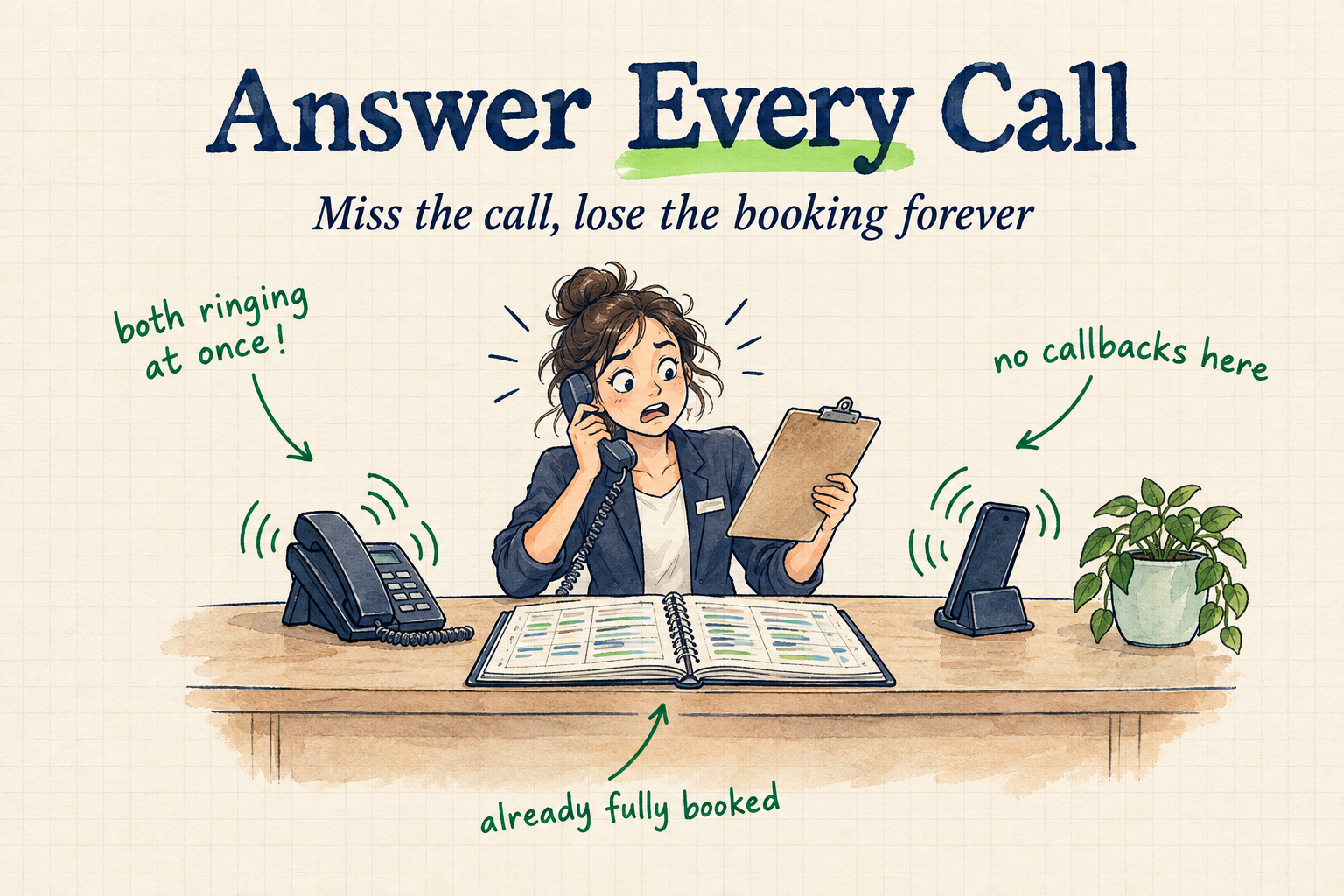
Google's AI Is About to Start Calling You
Google has been testing an AI-powered booking feature that can call local businesses on behalf of users to check availability and schedule appointments. You may have seen early versions of this — Google Duplex, which launched a few years ago, was the first iteration. The technology is getting more capable, and Google's continued investment in AI-assisted search and local discovery suggests this is a direction they're serious about.
Here's the part that matters for your business: when an AI places a call to book an appointment, it won't wait on hold. It won't call back tomorrow. It won't leave a voicemail and check in later. If your line is busy, unanswered, or the interaction goes sideways, the booking attempt ends — and that customer's request may get routed to whoever picks up.
What This Actually Looks Like in Practice
Imagine a potential customer searches for a med spa near them on a Saturday afternoon. Google's AI, acting on their behalf, calls your front desk to check availability for a facial appointment next week. Your front desk is slammed. The call goes to voicemail.
The AI doesn't leave a message and wait. It moves on.
Now imagine the same scenario, but your phone is answered on the second ring by a staff member — or by your own AI phone agent — who confirms availability, captures the appointment, and moves on to the next call. That's a booked appointment that would have otherwise walked out the door.
This isn't hypothetical in terms of the technology existing. What varies by market and business type is how quickly this becomes a real factor in your booking volume.
The Operational Problem This Exposes
Most service businesses already have a missed call problem. Front desk staff handle check-ins, existing customers, payment questions, and scheduling all at the same time. Calls get missed. Callbacks are slow. Voicemails go unreturned for hours.
That friction costs bookings today — before AI phone calls are even a factor.
When AI-driven booking attempts enter the mix, inconsistent phone coverage becomes more expensive. An AI calling on a customer's behalf has no patience for hold times or slow callbacks. The interaction either connects and converts, or it doesn't.
Consider a busy HVAC company during peak season. The office handles dozens of calls a day. Some get through, some don't. With AI-assisted booking becoming more common, each unanswered call isn't just a frustrated customer — it may be an automated system that's already moved on to a competitor by the time anyone calls back.
What You Should Do About It Now
You don't need to overhaul your business to prepare for this. You need to close the gaps that already exist.
1. Answer the phone — consistently. This sounds basic because it is. But many service businesses answer calls inconsistently, especially during peak hours, lunch, and after hours. Figure out where your coverage gaps are and fix them.
2. Extend your coverage hours. AI-driven searches happen outside of 9-to-5. If your phone coverage ends at 5 PM, you're leaving evening and weekend booking attempts unanswered. An after-hours answering solution — whether that's a service, an AI phone agent, or a clear callback system — can capture requests that would otherwise go cold.
3. Reduce friction in your booking process. If answering the phone is the easy part but actually booking the appointment takes five minutes of back-and-forth, that's its own problem. Your team should be able to confirm availability and schedule an appointment quickly. So should any tool you put in place.
4. Consider AI phone agents for overflow and after-hours. AI phone agents designed for service businesses can handle inbound calls, answer common questions, check availability, and capture booking requests. They're not a replacement for your team — they're coverage for the moments when your team can't get there. If an AI on the other end of a Google booking call reaches your AI agent and the appointment gets booked, that's a win.
The Bigger Picture
The businesses that will hold up well as AI-assisted search and booking evolves are the ones that are already easy to do business with. Fast to answer. Easy to schedule. Consistent in their follow-through.
This isn't about becoming a tech company. It's about removing the friction that already exists in your front-of-house operations — because those gaps matter more now than they did a few years ago, and they'll matter even more as AI-driven interactions become more common.
The competitive advantage here isn't adopting every new tool. It's running a business that's operationally tight enough to capture opportunities when they arrive — however they arrive.
If you're not sure where your biggest gaps are around phone coverage, response time, or booking friction, the free Operably audit is a good place to start. It takes about three minutes and gives you a clear picture of where you're losing bookings you should be keeping. Run it at operably.ai/audit.
Is this something your business needs?
Run the free audit to see which agents fit your operation — takes 3 minutes.
Stop executing. Start governing.
The worst case: you do the mapping session and leave with a clearer picture of what's costing you — before spending anything on a build.
Start with an operations audit →